Guide 1
Build, buy or adapt?
A plain method for comparing the three roads, with the questions that usually decide it.
Read the guideGeonavix Consultation helps organisations work out where they are, where they could go and which way is safest, before money goes into code. Then we help build and publish the mobile apps, web products and interfaces that the chosen route calls for.
Grid A1 · Legend
Six symbols, six kinds of help. Most projects use three or four of them, in an order that depends on where you are starting from.
Structured exploration of options: build, buy, adapt or wait. We map the terrain, name the risks and recommend a route with reasons you can check.
iOS and Android apps, cross-platform or native depending on what the route demands, built in short legs with a working build at each stop.
Web applications, portals and internal tools that run in any browser and load quickly on ordinary connections.
Interface and experience design treated as signage: people should always know where they are, where they can go and how to get back.
App store releases, listing preparation, privacy declarations and the documentation that gets a product across the border.
Maintenance, fixes and adjustments under agreed terms, handled during working hours from base camp.
Compass 01 · Decision route finder
Five questions, one suggested route with its first four waypoints. Change any answer to see how the route shifts.
Grid A2 · Why routes
Organisations rarely fail at software because developers cannot type. They fail because they built the wrong thing, or the right thing in the wrong order, or something that already existed off the shelf. Each of those is a navigation error made early, when it would have been cheap to check the map.
Our consulting work makes those early choices visible. We put the options side by side, show what each costs in time, money and risk, and recommend one, with the reasoning written down so you can disagree with it specifically.
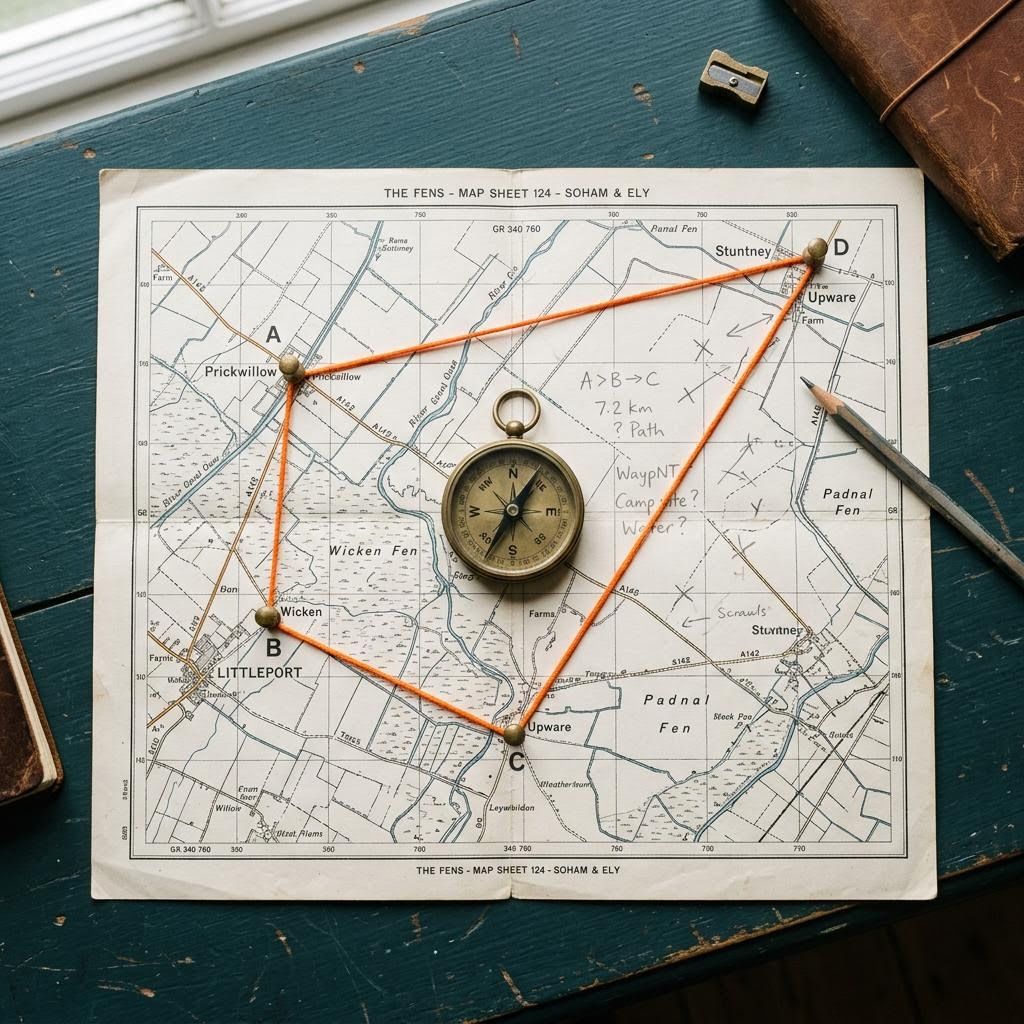
Grid B1 · The survey
A first conversation focuses on where you are now: who your users are, what they do today, which systems are already in place and which decisions are still open. We then propose a discovery phase sized to the uncertainty, sometimes a few days, sometimes a few weeks.
Discovery produces a short report, a journey map and usually a clickable prototype, so the decision about what to build rests on something people have actually tried. You can stop there and take the findings anywhere. How an expedition runs.
Grid B2 · Mobile & web
The choice of platform is a route decision with lasting consequences. These are the three paths we most often recommend, and when.
For products that live on the device: heavy camera use, sensors, background location, demanding performance. Highest reach into each platform, highest cost to maintain two codebases.
One shared codebase for iOS and Android. Sensible for most products built on lists, forms, accounts and content, with native modules where needed.
A responsive web product reaching every device without stores. Ideal for occasional use, internal tools and testing demand before an app.
Grid C1 · Wayfinding
The best path signs answer three questions at a glance. So should every screen. We design interfaces using the same principles that guide walkers across open country.
Clear titles, current location in navigation, progress in multi-step tasks.
One obvious next action per screen; alternatives visible but quieter.
Undo, back and cancel that never lose what someone typed.
Warnings before destructive actions, written in plain English.
Compass 02 · Build, buy or adapt
Give each criterion a weight (0–5) and score each option (0–5). The totals are weight times score. Rename criteria by editing your own copy offline; the defaults are typical starting points.
| Criterion | Weight | Build | Buy | Adapt |
|---|---|---|---|---|
| Fits our process exactly | ||||
| Cost in year one | ||||
| Speed to first use | ||||
| Control over the future | ||||
| Maintenance burden |
Grid C2 · Publishing
Publishing an app is a checkpoint process: accounts, listings, privacy declarations, review, release. We prepare every document the reviewers will ask for and walk you through the identity checks for your own developer accounts.
Grid D1 · Standards
The commitments that hold on every route we travel with a client.
| 01 | Show the map | Written options and reasoning before any significant commitment, with the trade-offs stated. |
|---|---|---|
| 02 | Short legs | Work in increments of one to two weeks, each ending in something you can open and try. |
| 03 | Your vehicle | Code, accounts and documentation belong to you from the first day. |
| 04 | Everyone can travel | Design and testing towards WCAG 2.2 AA, with any gaps reported openly. |
| 05 | Light luggage | Collect only the data a product needs; describe it honestly. |
Compass 03 · Discovery planner
Estimate the size of a discovery phase before any build begins. Each square is one working day: orange for research, aqua for prototyping and testing.
Grid D2 · Field guides
Guide 1
A plain method for comparing the three roads, with the questions that usually decide it.
Read the guideGuide 2
What a good one contains and the warning signs of a weak one.
Read the guideGuide 3
Seven symptoms that a software project has drifted off its route, and how to reorient.
Read the guideGrid E1 · Base camp
Clients with a support agreement log issues through the support page, which gives each request a reference. We respond during working hours, Monday to Friday, 09:00 to 18:00 UK time, according to the priorities agreed in writing.
Open a support requestGrid E2 · Set out
You do not need a specification. A paragraph about the decision in front of you is enough to start. We reply by email with questions or a suggested first conversation.